
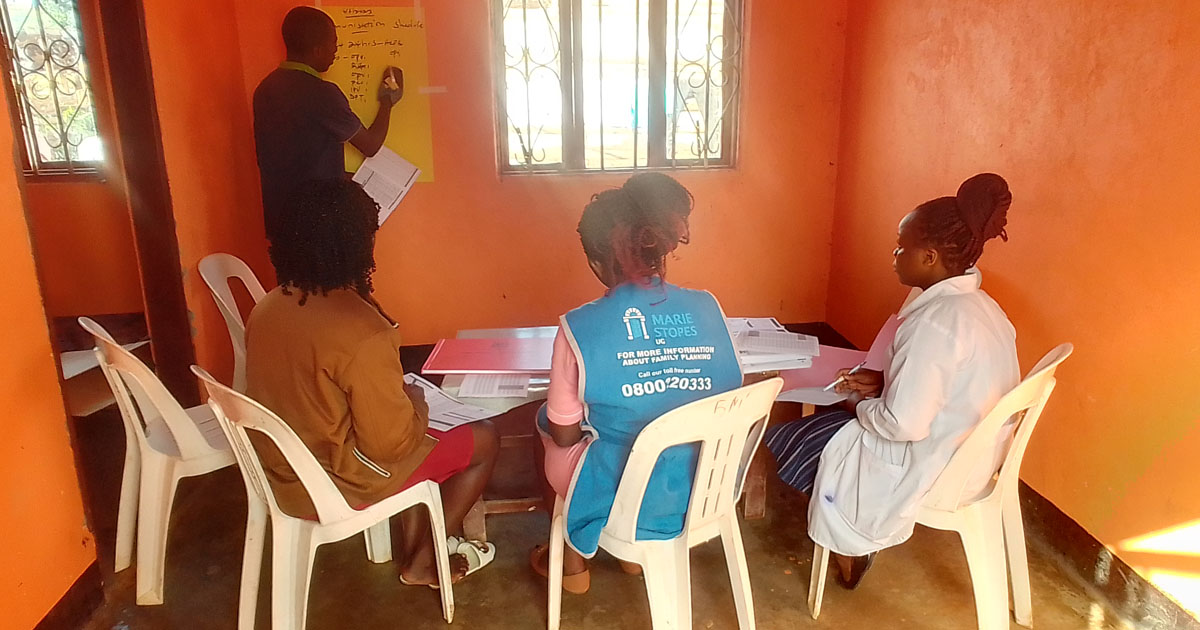
This exercise took place on 6thJune 2023 at Busesa Medical Centre III whereby Mr. Henry Karamogi the mentorship on Immunization (EPI services) said that this is To ensure the effective storage of vaccines, including COVID vaccines, the Expanded Programme on Immunization (EPI) of the Ministry of Public Health and the Fight Against AIDS (MSPLS) has strengthened the skills of its maintenance technicians in the preventive maintenance and repair of solar refrigerators.
He continued by saying that Immunization is unquestionably one of the most cost-effective public health interventions available ant In order to improve its accessibility to children worldwide, the World Health Organization (WHO) launched the Expanded Program on Immunization (EPI) in 1974 with as objective to prevent seven of the most serious diseases.
He also said that being aware of the important role of the cold chain in maintaining the effectiveness of the vaccines, in improving equity and in increasing immunization coverage, the EPI, with the support of its partners, has clearly improved its equipment by installing equipment approved by the World Health Organization.
Similarly, Mid NAMIRIMU JOSEPHINE the immunization in charge at Busesa Medical Centre III says she has experienced the same problems, but is now confident: “this training is important for me because it will provide us with the necessary knowledge to manage the vaccines properly”, she said.
Mr. Henry Karamogi also said that UNICEF is a privileged partner of the Ministry of Public Health and the Fight against AIDS (MSPLS) in the strengthening of the vaccine cold chain, in particular for the provision of cold chain equipment and for the maintenance of these equipments.
In his conclusion therefore he said that although, we cannot infer the results of this study to all Ugandans, its findings described weaknesses in cold chain maintenance in the country and pulling the communication cord is therefore needed for action in the whole country. The failure of the cold chain maintenance documented here questions the efficacy and safety of vaccines that are administered during EPI vaccination sessions in Uganda. This can have as consequences, loss of potency of administered vaccines, low immunization coverage rate, increasing incidence of cases of disease and adverse events following immunization among vaccinated persons. To improve this situation in Uganda we recommend:
- To map access to power supply in health facilities in charge of implementing EPI activities and provide those with no access to hydroelectricity with alternative sources of power like solar, kerosene and gas and adapted refrigerators and freezers.
- Insure that all health facilities involved in EPI activities have adequate cold chain equipment (refrigerator and or freezer).
- Provide health facilities with access to hydroelectricity with secondary sources of power.
- Insure that all health facilities implementing EPI activities have the Standard Operating Procedure for EPI in Uganda.
To District and regional health authorities:
- Insure that refrigerators and freezer used to stored vaccines are equipped with all recommended tools,
- Organize to prevent power interruption in health facilities by stocking alternative sources of power like solar, gas and kerosene,
- Appoint in all health facilities, health personnel for cold chain monitoring and evaluate, train and supervise them at a reasonable periodicity,
- Identify and address factors leading to failure of cold chain monitoring.
- Sponsors and researcher should work to manufacture thermos table vaccines, provide all vaccine with Vaccine Vial Monitor and to computerize cold chain temperature monitoring.